
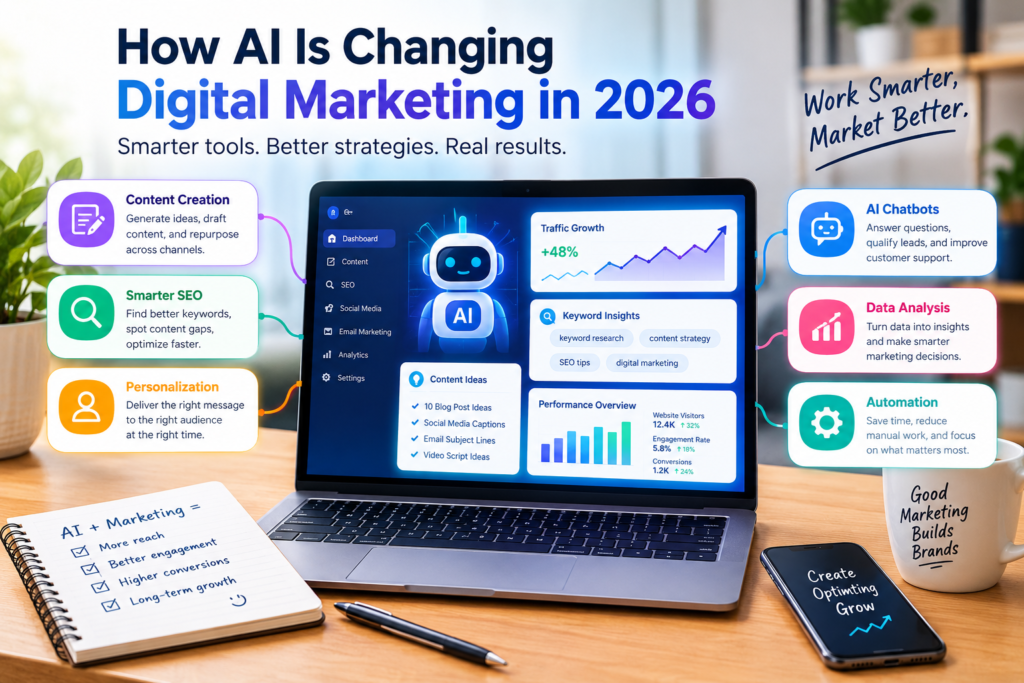
Digital marketing is evolving faster than ever, and artificial intelligence (AI) is playing a major role in that transformation. From personalized advertisements to AI-powered content creation, businesses are finding new ways to connect with customers, save time, and improve their marketing strategies.
Whether you’re a blogger, business owner, content creator, or marketing beginner, understanding AI can help you stay competitive in the digital world.
But how exactly is AI changing digital marketing, and how can you use it effectively? Let’s explore.
What Is AI in Digital Marketing?
AI in digital marketing refers to using artificial intelligence technologies to analyze data, identify patterns, automate tasks, and improve marketing decisions.
Traditionally, marketers spent hours researching keywords, analyzing customer behavior, writing content, and managing advertising campaigns. AI tools can now assist with many of these activities, helping marketers work more efficiently.
For example, an AI-powered tool can help a blogger brainstorm article topics, suggest relevant keywords, summarize research, or develop an outline for a new blog post.
However, AI isn’t a replacement for human creativity. The best results often come when marketers combine AI’s speed with their own experience, judgment, and understanding of their audience.
1. AI Is Making Content Creation Faster
Creating quality content consistently is one of the biggest challenges in digital marketing. AI tools can make the process easier by helping marketers generate ideas, organize information, and improve their writing.
Here are some ways AI can support content creation:
- Blog writing: Generate topic ideas, outlines, headlines, and first drafts.
- Social media: Brainstorm captions, post ideas, and content calendars.
- Email marketing: Draft newsletters and suggest subject lines.
- Video marketing: Develop scripts, summaries, and video concepts.
- Content repurposing: Turn a blog post into social media updates or an email newsletter.
For example, a blogger writing about SEO could use an AI assistant to brainstorm ten article ideas related to keyword research.
The blogger could then research the most promising idea, add practical examples, verify the facts, and publish an original article.
The key is to use AI as a starting point, not as a substitute for valuable, original content. Always review AI-generated material for accuracy, usefulness, originality, and relevance.
2. Smarter SEO and Keyword Research
Search engine optimization (SEO) helps websites attract visitors through organic search results. AI is making several parts of SEO more efficient.
AI-powered tools can help marketers identify keyword opportunities, group related search terms, analyze content gaps, and understand search intent.
For example, someone running a technology blog might start with the keyword “cybersecurity tips.” By researching related queries, they could discover opportunities to write about password security, phishing prevention, and online privacy.
Instead of publishing one broad article, the blogger could develop several focused posts that address specific reader needs.
AI can also assist with content audits and internal-linking suggestions.
However, AI-generated keyword recommendations aren’t automatically accurate or valuable. Marketers should still evaluate search intent, competition, audience relevance, and available search data before choosing which keywords to target.
3. Personalized Marketing Is Becoming More Effective
Today’s customers expect relevant experiences. They are more likely to engage with content, offers, and recommendations that match their interests.
AI can help businesses personalize marketing by analyzing patterns in customer behavior and preferences.
For example, an online bookstore might recommend books based on a customer’s previous purchases or browsing activity. An email marketing platform might help a business segment subscribers according to their interests.
Personalization can make communication more useful and improve the customer experience.
However, businesses must handle customer information responsibly. Transparency, appropriate consent, and respect for privacy should remain essential parts of every marketing strategy.
4. AI Chatbots Are Improving Customer Support
Customers often want quick answers about products, services, shipping, pricing, or business hours. AI-powered chatbots can help businesses respond to common questions without requiring a team member to handle every interaction manually.
For small businesses, this can be particularly helpful.
Imagine a digital marketing agency receiving repeated questions about its services. A chatbot could answer basic inquiries, explain available packages, and direct visitors to relevant website pages.
More advanced systems can assist with lead qualification and appointment scheduling.
Still, chatbots have limitations. They may misunderstand questions or provide incorrect answers. Businesses should offer a clear way to contact a human when a question requires personal attention or expert judgment.
5. Better Data Analysis and Marketing Decisions
Digital marketing generates enormous amounts of data, including website visits, email clicks, social media engagement, and advertising performance.
Understanding this information can be difficult, especially for beginners.
AI tools can help marketers identify patterns, summarize reports, and highlight areas that may need attention.
For instance, if a blog receives plenty of visitors but few newsletter subscriptions, a marketer could investigate whether the signup form is difficult to find or whether the newsletter offer provides enough value.
The important thing is to treat AI-generated insights as recommendations to investigate, rather than unquestionable conclusions.
Good marketing decisions combine data, business goals, and an understanding of real customer needs.
6. How Beginners Can Start Using AI in Digital Marketing
You don’t need advanced technical skills or a large budget to begin experimenting with AI.
Here are five practical steps:
- Choose one task. Start with something manageable, such as brainstorming blog topics or drafting social media captions.
- Explore suitable tools. Try an AI assistant, keyword research platform, or email marketing tool that fits your needs.
- Set a clear objective. Decide whether you want to save time, improve content quality, or better understand your audience.
- Review every result. Check facts, remove generic language, and add your own knowledge and experience.
- Measure the outcome. Track useful indicators, such as engagement, qualified website traffic, or newsletter signups.
Start small and focus on solving real problems. You can expand your use of AI as you learn what works for your audience.
Conclusion
Artificial intelligence is changing digital marketing by helping businesses create content, improve SEO research, personalize customer experiences, automate routine tasks, and analyze performance.
But AI alone doesn’t guarantee marketing success. Strong strategies still depend on understanding your audience, delivering genuine value, protecting customer privacy, and making informed decisions.
For bloggers, marketers, and business owners, the best approach is to combine AI’s efficiency with human creativity and critical thinking.
The future of digital marketing isn’t simply about using more AI. It’s about using AI intelligently to create better experiences for real people.
Start experimenting with one practical application today, learn from the results, and build your strategy from there.
SEO Details for BloggersBuzz
SEO Title: How AI Is Changing Digital Marketing in 2026
Focus Keyword: AI in digital marketing
Related Keywords:
- Artificial intelligence in marketing
- AI marketing tools
- AI for SEO
- Digital marketing trends
- AI content creation
- Marketing automation
Meta Description: Discover how AI is transforming digital marketing through content creation, SEO, personalization, chatbots, and data analysis.
Suggested URL Slug: ai-in-digital-marketing-2026
Suggested Category: Digital Marketing
Suggested Tags: Artificial Intelligence, Digital Marketing, SEO, Content Marketing, Marketing Automation
Suggested Featured Image: A modern digital marketing workspace featuring AI-powered analytics dashboards, SEO charts, content creation tools, and automation icons.